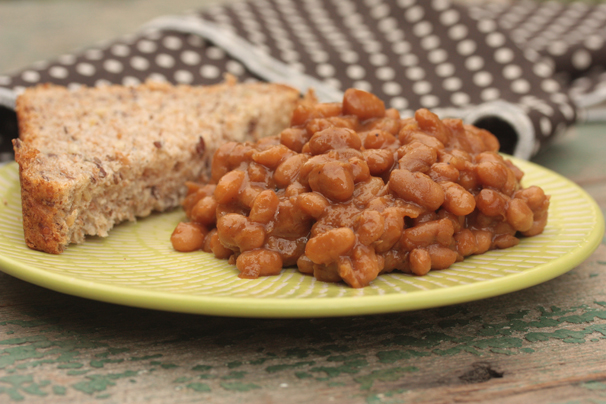
I find that people tend to be amazed that I make baked beans from scratch. Maybe they find the 5+ hours of baking time intimidating. But have no fear – baked beans are actually super easy to make.

However, they do require one big decision up front: whether to include ketchup or any other tomato products.  Anyone  from New England will be solidly in the no-tomato camp.  In other parts of the country, you not only find ketchup in baked beans, but cinnamon, apple juice, soy sauce and kinds of other crazy stuff. Me, I’m from upstate New York – that’s not quite New England, but today I’m siding with the Bostonians. My recipe is traditional in its tomatoless-ness, though nontraditional in its meatless-ness.  I used smoked paprika – my secret weapon – and a bit of olive oil as a stand-in for bacon or salt pork. I think the result is good enough to satisfy your friendly neighborhood meat eater – and I don’t think anyone will really miss the ketchup.

This recipe makes a huge batch of beans, but you will be very happy to have a lot of leftovers. In fact, if you’re anything like my father, you might find yourself eating them cold for breakfast, along with some eggs and toast.

Vegetarian Boston Baked Beans
2 pounds dried navy beans
1 tablespoon dry mustard
2/3 cup molasses – I used blackstrap, but you can sub. “full”/”robust” for a slightly sweeter flavor
1/2 cup packed brown sugar
3 cloves garlic, minced
1 tablespoon Spanish smoked paprika
1/4 cup cider vinegar (use gluten-free vinegar if you prefer)
1 tablespoon Worcestershire sauce (can substitute vegan version)
2 tablespoon extra virgin olive oil
2 teaspoons salt
1/2 teaspoon freshly ground black pepper
Pinch cloves
2 large onions, sliced
2 bay leaves

Soak the beans overnight, or use the quick soak method (bring the beans to a boil in a pot of water, boil 2 minutes, cover and remove from heat for 1 hour. Drain.)

Place the soaked beans in a large saucepan and cover with water by 2 inches. Bring to a boil, reduce heat and simmer until nearly tender, about 30 minutes to 1 hour depending on your beans. (If your beans are still rock hard after an hour, discard them – they are probably too old and may never soften, or will do so at the expense of your patience.)  Drain the beans, reserving the cooking water.

Heat the oven to 300 degrees.

In a large bowl, combine the mustard, molasses, brown sugar, garlic, paprika, vinegar, Worcestershire sauce, cloves, olive oil, salt and pepper. Put a third of the cooked beans in a large covered bean pot or dutch oven, and cover with half the onions. Repeat, then top with the final third of the beans. Tuck the bay leaves into the pot. Pour on the sauce, then add bean cooking liquid to cover generously (about 6 cups; if you don’t have enough bean cooking liquid, add water.)

Cover and bake for 4 hours, checking occasionally to make sure the beans aren’t getting extremely dried out – add hot water if they are. After 4 hours, taste and add additional salt if you feel it’s needed, and bake  uncovered for an additional 45 minutes to one hour, until sauce is thickened and beans develop a bit of a crust on top.  (Note that beans will thicken significantly as they cool.) Remove bay leaves and serve, or serve later at room temperature or cold right from the refrigerator.

Serves 16-20
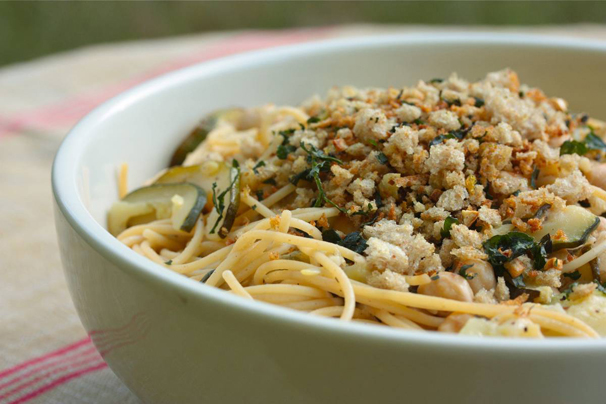
For part two of my quest to use up a mountain of zucchini from my garden, I considered making a simple pasta dish – saute squash with garlic and throw it on spaghetti. But I decided to make it more of a nutritious meal by adding chickpeas, and more interesting by adding crispy breadcrumbs with the ingredients of gremolata: parsley, garlic and lemon zest.

Between the sweetness of the zucchini, the tartness of the lemon and the crunch of the breadcrumbs, this dish is the perfect intersection of flavor and texture. So go pick your squash – either out of the ground or at the farmer’s market. Just don’t try to give your extras away to me. I’m still drowning in the stuff.

Pasta with Zucchini, Chickpeas and Gremolata Breadcrumbs

2 tablespoons + 2 teaspoons extra virgin olive oil, plus more for serving

4 cloves garlic, divided

1 cup freshly made breadcrumbs from good-quality whole wheat or other bread

Grated zest of one lemon

2-3 tablespoons chopped flat-leaf parsley

3 medium zucchini (I used one small and one huge), sliced lengthwise and then thinly sliced into half-moons

½ teaspoon crushed red pepper flakes, or to taste

Juice of ½ lemon

1 15-oz can chickpeas, drained

½ teaspoon salt

Freshly ground black pepper

¾ pound whole wheat or whole grain blend spaghetti

To make the gremolata breadcrumbs, heat 2 t. olive oil in a skillet, add half the garlic and sauté for 1-2 minutes. Add the bread crumbs, lemon zest and parsley and cook, stirring frequently, for 5 minutes or until bread crumbs are browned and crispy. Set aside.

Heat the remaining olive oil in a large skillet. Add the zucchini and red pepper flakes, and cook over medium heat, turning frequently with a spatula, until the zucchini is starting to turn golden (about 10 minutes). Add the remaining garlic during the last 3 minutes of cooking time. Stir in the chickpeas, lemon juice, salt and a generous amount of black pepper.

Meanwhile, heat a large pot of water and cook the pasta until al dente. Drain, reserving 3/4 cup of the cooking liquid.  Add the reserved liquid to the zucchini mixture and cook for 2 additional minutes.  Combine the pasta and squash, and stir gently. Serve topped with the breadcrumbs and a drizzle of olive oil.

Serves 4.

Jul 6, 2010

Vegetarian pozole

I can’t count how many bowls of porkalicious pozole I consumed during my decade in San Francisco.  Now, my arteries prevent me from indulging in that traditional dish. I was skeptical about vegetarian pozole, but after one taste of this version I created, it has rocketed to the top of my list. It gives me that same old pozole thrill!  This is a great party dish, because people enjoy the process of adding all the essential toppings: cilantro, thinly sliced radishes, cabbage, roasted pepitas, avocado and lime. The mix of flavors and textures is simply spectacular.

I started with Rancho Gordo’s recipe and branched out from there. The major enhancement was ground pepitas, which give the dish much more body and depth of flavor. For the hominy, I used RG’s “Prepared Posole,” which is not difficult to cook, but takes some time.  You can substitute canned hominy if you’re in a rush, although you won’t get the same intense corn flavor. Trust me, making pozole from scratch is well worth the effort.

Vegetarian Pozole

1 cup whole dried hominy
2/3 cup roasted, lightly salted pepitas (pumpkin seeds) – half reserved for garnish
1 medium red onion, thickly sliced
1 serrano pepper, stemmed
3 cloves garlic, peeled
12 tomatillos, papery skins removed, rinsed
1 tablespoon olive oil
1 teaspoon ground cumin
1 teaspoon dried Mexican oregano
1 cup cilantro leaves
1 4-ounce can fire roasted green chiles (Ortega makes these, or use Hatch chiles if you can find them)
4-5 cups vegetable broth (use gluten-free broth if you are gluten-sensitive)
Salt to taste

For garnish:

cilantro
thinly sliced radishes
cubed avocado
dried Mexican oregano
Roasted pepitas
Very thinly sliced green cabbage
Lime Wedges

Place hominy in a large bowl and cover generously with water.  Soak for 6 hours or overnight, then drain. Place it in a saucepan with water to cover generously, and cook according to the package directions (for Rancho Gordo’s hominy, bring to a boil, reduce heat and simmer, partially covered, until tender, about 2 1/2 to 3 hours.)  Season with a little salt and cool in the liquid.

Bring a pot of water to boil in a saucepan and add the tomatillos.  Simmer until tender, 10-12 minutes. Drain and set aside.

On a hot, dry skillet (cast iron works best), roast the onion, serrano peppers and garlic, turning occasionally until they are nicely charred, about 15 minutes. Remove to a plate to cool.

In the same skillet, toast the ground cumin and the oregano over medium-low heat for one minute, then add the olive oil and cook for an additional minute.

Put the oil/spice mixture, the charred vegetables, 2 cups broth, cilantro, canned green chiles, prepared tomatillos and half the pepitas in a food processor and puree until smooth.

Pour the mixture into a large dutch oven. Add 2 cups additional broth, and simmer for 10 minutes. Add an additional cup of broth if the mixture seems too thick. Season with salt to taste. Add the drained cooked hominy, return to a simmer and serve. Add garnishes to individual bowls.

Serves 4-6